

"Hey, how do I get better?"
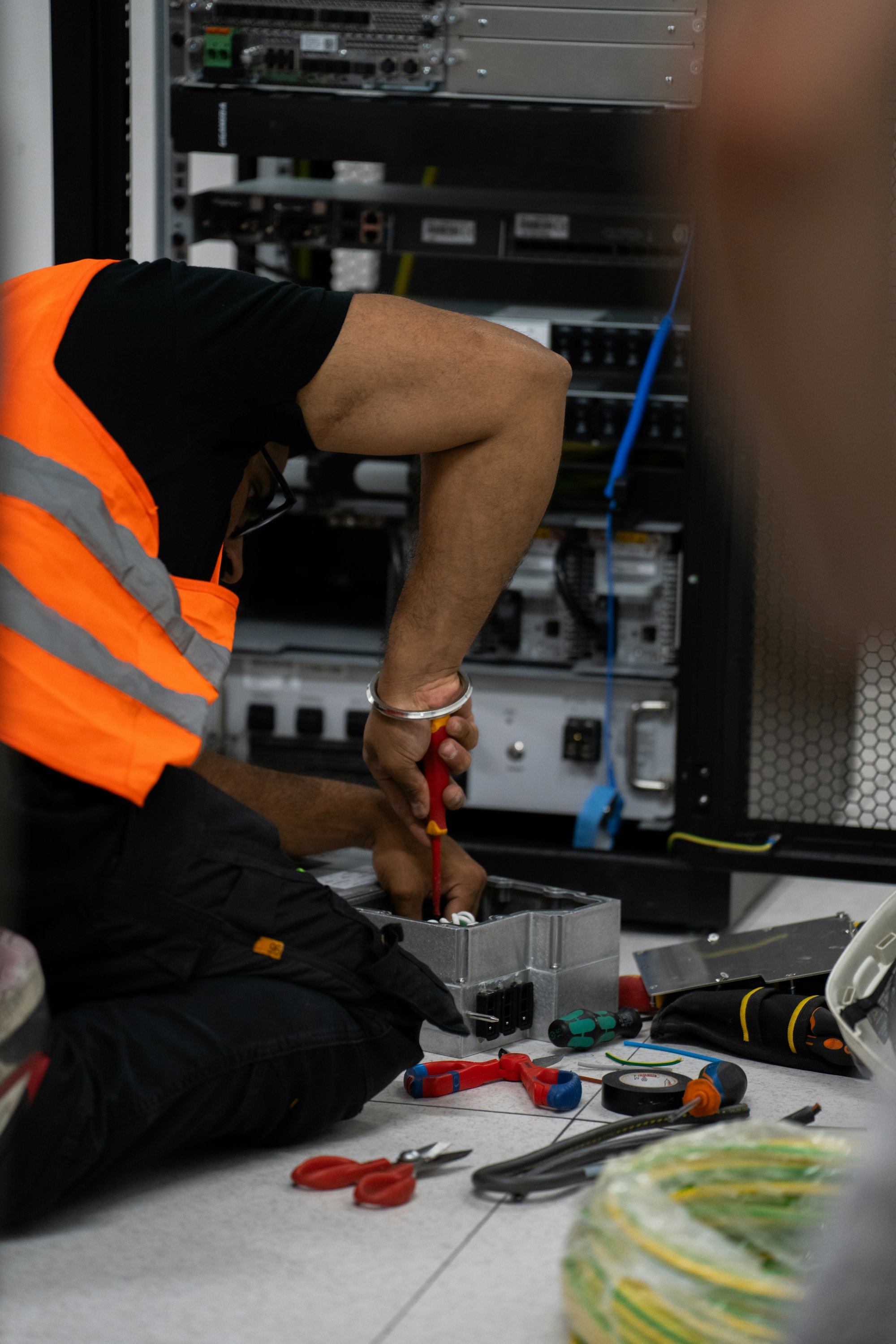
That is the question I hear most from young engineers. The ones who spend their days hugging servers, plugging in network cables, installing drives, building RAID, and chasing beeps in the middle of the night.
I have seen people who, less than five years out of school, were already designing entire systems for large customers. I have also seen people with more than ten years who were still just the ones being handed tasks. The difference is not the number of years. It is which steps they have managed to climb.
And at some point, the question changes to: "Should I go deep into technology, or turn toward business?" This post is my answer.
A map of two paths
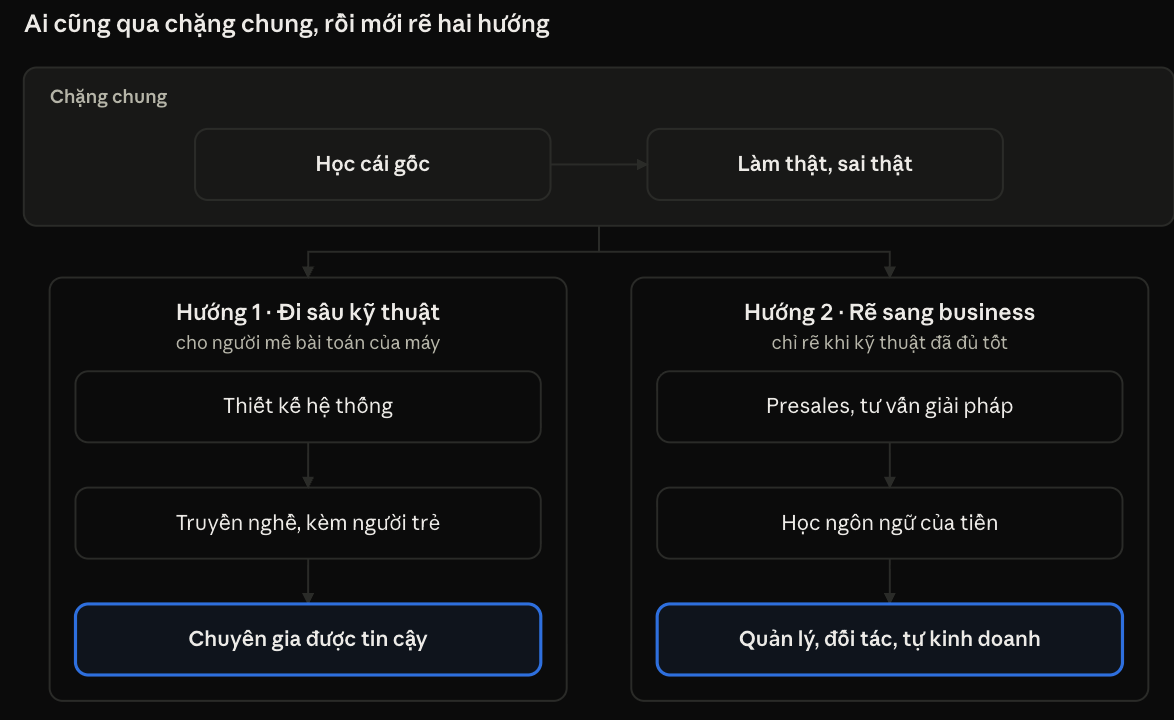
The first two steps are a common foundation, and no one can take a shortcut around them. After that, each person chooses the problem they want to solve: the machine's, or the people's.
The shared stretch: everyone has to go through it
Before turning in either direction, there are two steps that no one can skip.
Step one: learn the roots, not the branches. In the early years, everyone gets swept into an endless list: CCNA, Linux, Windows Server, virtualization, cloud, security, and now AI. The more you learn, the more you feel you are missing. I was like that too.
But technology changes very fast, while the roots barely move. Understand power, temperature, and airflow inside a rack, and you will understand why a server dies. Understand how a hard drive writes data, and you will understand RAID, and why a backup is never too much. Understand TCP/IP, and every new network device is just another interface. Do not study to collect certificates. Study so that at 2 a.m., when the system goes down, you know what to check first.
Step two: do it for real, and get it wrong for real. In the lab, every exercise has an answer. In real life, the customer only calls with one sentence: "Hey, the machine is too slow." Then you have to trace the logs yourself, check every drive, every cable, every fan, ruling out one possibility at a time.
I have never seen anyone get better by reading one more book. But I have seen many people change completely after a few months on incident duty and deploying real projects. Every incident is a lesson no school teaches. What is frightening is not making mistakes, but never having dared to put your hands on a real system.
Path one: go deep into technology
If you love the feeling of opening up a server, listening to the fans and guessing where it is "sick", this path is for you.
From doer to designer. At this step, you no longer ask "how do I configure this?" You ask: if the data triples, can the storage handle it? If one drive dies, and then another dies while it is rebuilding, what then? If the whole server room loses power, how long before the business is running again? You start weighing performance, availability, security, cost, and operations for the next five years all at once. At that point, you are no longer "doing technical work". You are designing the future of a system.
From designer to teacher of the craft. The best experts I have met all love sharing. They mentor interns, write blogs, and teach internal training classes. Not because they have free time. But because they understand that knowledge is truly yours only when you can explain it so that others understand.
The destination of this path is the day when customers and colleagues can both say with peace of mind: "With him here, the system will be fine." No certificate on the wall and no title on a fancy business card is as beautiful as that sentence.
Path two: strong enough in technology, then turn to business
Some engineers, after a few years, start to get curious about things outside the rack. Why do customers choose this vendor and not that one? Why, with the same set of solutions, can one person sell and another cannot? That is when the second path opens up.
What I want to emphasize is the words "good enough". Do not turn too early. A businessperson who once built systems with their own hands, who once stayed up all night handling an incident, has something others find very hard to have: trust. When customers listen to you, they know you truly understand, rather than reciting a catalogue.
The first step is usually presales, solution consulting. You still use your technical knowledge, but to answer the customer's questions rather than the machine's. Customers do not buy hard drives; they buy the peace of mind that their data will not be lost. Customers do not buy servers; they buy the assurance that their company will not freeze on a Monday morning.
Then you learn a new language: money. Investment cost, operating cost over many years, the risk of doing nothing at all. You learn to listen more than you talk, how to write a clear quotation, how to keep your word after the contract is signed. These things are no less hard than debugging a server; they are just hard in a different way.
And further on, it might be managing a business line, becoming a partner of a vendor, or opening your own company. By then, your technical foundation from years ago becomes your biggest advantage.
Either path is fine, as long as you do not stand still
No path is higher than the other. A great technical expert and a great businessperson are both rare, and both are paid what they deserve.
The right question is not "which path earns more money", but "do I enjoy solving the machine's problems, or the people's problems?" If you are happy when a system runs smoothly, go deep. If you are happy when a customer nods and trusts you, try turning.
There are only two things I hope you remember. One: do not skip the shared stretch. Technology is the foundation, no matter what kind of house you build later. Two: whichever path you take, share what you know. That is how this profession grows, and it is also how you grow.
Learn to understand. Do to grow. Design to lead. Share so that something remains.
Do what you love, and love what you do.
Which fork in the road are you standing at? Let me know.