
When the boss asks: “Why did the AI alert like that?”
Imagine you have just finished handling a major incident. Tomorrow morning there is a postmortem meeting with the leadership. In your report, you don't only have to tell what happened, you also have to answer: why did the AI monitoring system raise the alarm early, or worse, why did it stay silent?
In the old days, we infrastructure engineers lived with Syslog, SNMP, CLI, Wireshark, routing tables and the little LEDs on the front of a server. Now every tool has the word AI stuck on it: failure prediction, anomaly detection, log reading, configuration suggestions, even writing the root-cause report for you.
The problem is that most of us use AI as a black box. We see data go in, we see results come out, and what happens in between is a blur. When AI only suggests a file name, that's fine. When it affects decisions on a production system, we need to understand what it is doing.
This post is longer than usual for Rino, and more technical than usual. I will open four boxes: Neural Network, GPT, GAN and VAE. You don't need to become a data scientist, just understand enough to know when to trust and when to doubt.
Neural Network: the foundation of everything
Almost every modern AI system is built on artificial neural networks (ANN). The idea is inspired by the human brain: a great many small “neurons” connected to one another, arranged in layers.
The input layer receives raw data.
The hidden layers transform the data through step after step of computation.
The output layer returns the result: a number, a label, a probability.
Each connection between two neurons has a weight. Each neuron sums the incoming signals according to their weights, passes the sum through an activation function, and then forwards it. “Training” is really adjusting millions of those weights, bit by bit, so that the output matches reality. The more hidden layers a network has, the more complex patterns it can learn. That is why it is called Deep Learning.
An example from the server room. For hardware people, the most familiar problem is predicting that a device is about to fail. The input could be a hard drive's SMART indicators, temperature, fan speed, the number of errors on a network port, CPU and RAM usage, latency, packet loss rate. The output is a probability, something like: “The drive in slot 4 is very likely to fail in the next few days.”
What to remember: that probability is not a prophecy. It only reflects what the model has seen in its training data. If the data contains only drives from one manufacturer, the model may guess very wrongly for drives from another.
GPT and Transformer: why chatbots now “understand” what we say
GPT stands for Generative Pre-trained Transformer. Three words, three ideas.
Generative: the model creates new content. A piece of switch configuration, a Python script, an Ansible playbook, a log summary, a draft root-cause report for an incident.
Pre-trained: the model is trained beforehand on a huge collection of text including books, technical documents, web pages and source code. It can then be fine-tuned further for a narrow field such as networking, security or storage.
Transformer: an architecture introduced by a research team at Google in 2017, in the famous paper “Attention Is All You Need”. At its heart is the attention mechanism: for each word, the model weighs for itself which other words in the sentence deserve the most attention.
Say you type: “OSPF neighbor doesn't come up after changing the Area ID.” An old-style chatbot searches by keyword, sees “OSPF” and returns a generic article about OSPF. A model using attention can connect “neighbor”, “doesn't come up” and “changing the Area ID” to each other. It understands that this is about two routers with mismatched areas, and suggests checking the right place.
In operations. When connected to logs, tickets and configuration change history, a GPT-style assistant can answer a question like “Why has branch A lost its VPN since 21:42?” It gathers Syslog, SNMP traps, related tickets and nearby changes, then builds them into a timeline. Work that takes hours can be cut down to a few minutes.
But remember its nature: GPT predicts the most plausible next word, it does not “know” the truth. It can write a command that looks very convincing but that your device doesn't support at all. This is called hallucination, and it is the number one reason never to paste AI-written configuration straight into production.
GAN: two neural networks outwitting each other
The GAN (Generative Adversarial Network) was introduced by Ian Goodfellow and colleagues in 2014. The idea is very “down to earth”: make two models compete with each other.
The Generator is the forger. It creates fake data.
The Discriminator is the ticket inspector. It guesses which data is real and which is fake.
The forger tries to get past the inspector. The inspector tries to catch every fake. The two train each other over many rounds, until the fakes are almost indistinguishable from the real thing. Just like counterfeiters and the police: when one side gets better, the other is forced to get better too.
GANs are most famous for images, but in infrastructure they have two very practical uses.
Generating training data without exposing real data. A company's real logs contain internal IPs, usernames, customer information. Many organizations don't want to, or aren't allowed to, use them to train models. A GAN can produce “synthetic” Syslog, NetFlow and packet traces that keep the statistical characteristics of the original data but contain no real information.
Testing your defenses. A GAN can generate abnormal traffic and simulate attack behavior, to check whether your IDS, IPS, NDR or SIEM can catch it. A kind of fire drill, but for the network.
The hard part of a GAN is that training is very “fussy”: it easily becomes unbalanced, and easily falls into producing only a few similar-looking kinds of data. However good the synthetic data is, you still have to check it against real data before trusting it.
VAE: catching anomalies by “redrawing it differently”
The VAE (Variational Autoencoder) was proposed by Kingma and Welling in 2013. It belongs to the family of representation learning, and has two halves:
The Encoder compresses data into a very small space, keeping only the most important features.
The Decoder rebuilds the original data from that compressed version.
It sounds like compressing and decompressing a file. The difference is that a VAE doesn't memorize every byte, it learns the general “shape” of the data. Like a veteran on-call engineer who looks at a traffic chart and knows that today something is “not like other days”.
Anomaly detection. This is the most common use in operations. We train the VAE only on normal data: NetFlow, Syslog, telemetry from quiet days. The model becomes very good at redrawing “an ordinary day”.
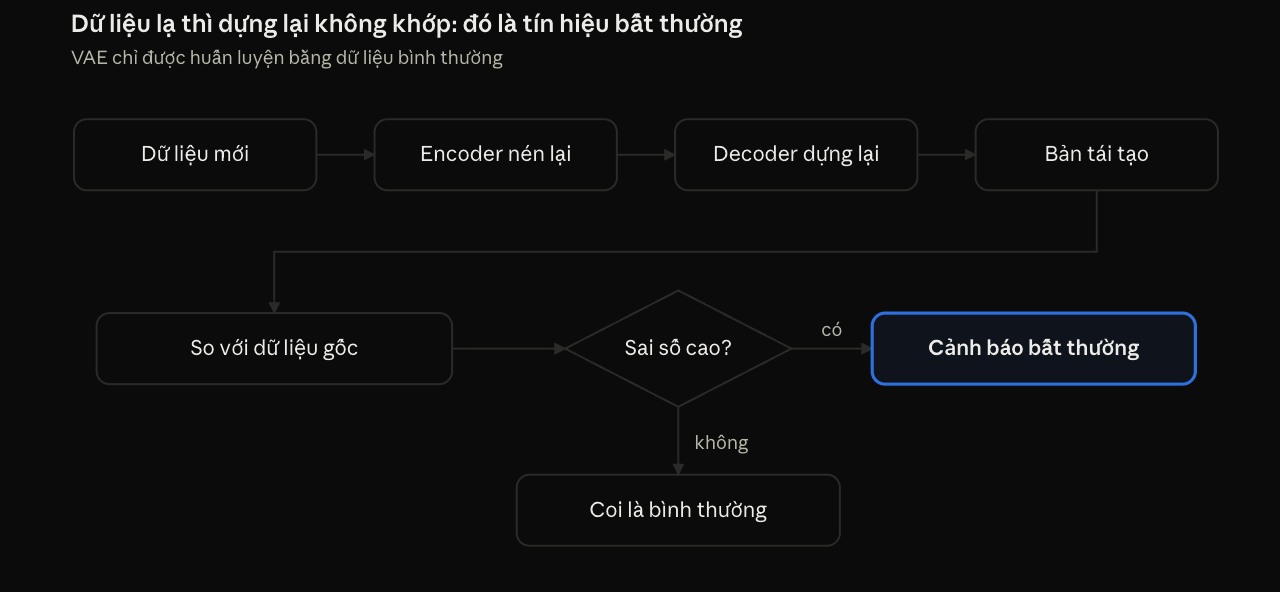
Then one day there is a DDoS, or malware constantly calling back to a command-and-control server, or someone quietly pulling data out. The VAE has never seen these things, so it rebuilds them very badly. The gap between the original data and the rebuilt version, called the reconstruction error, shoots up. Once it crosses a threshold, the system raises a flag. Many NDR and AIOps solutions use a similar approach.
But for exactly that reason, a VAE can't tell “unusual because of an attack” from “unusual because of a firmware upgrade” or “unusual because the month-end reports are running”. It only knows it's unusual. Answering “unusual why” is still the engineer's job.
Reading AI results like an engineer
What is the point of understanding the four concepts above? So that whenever AI gives an alert or a suggestion, we know how to ask the right questions.
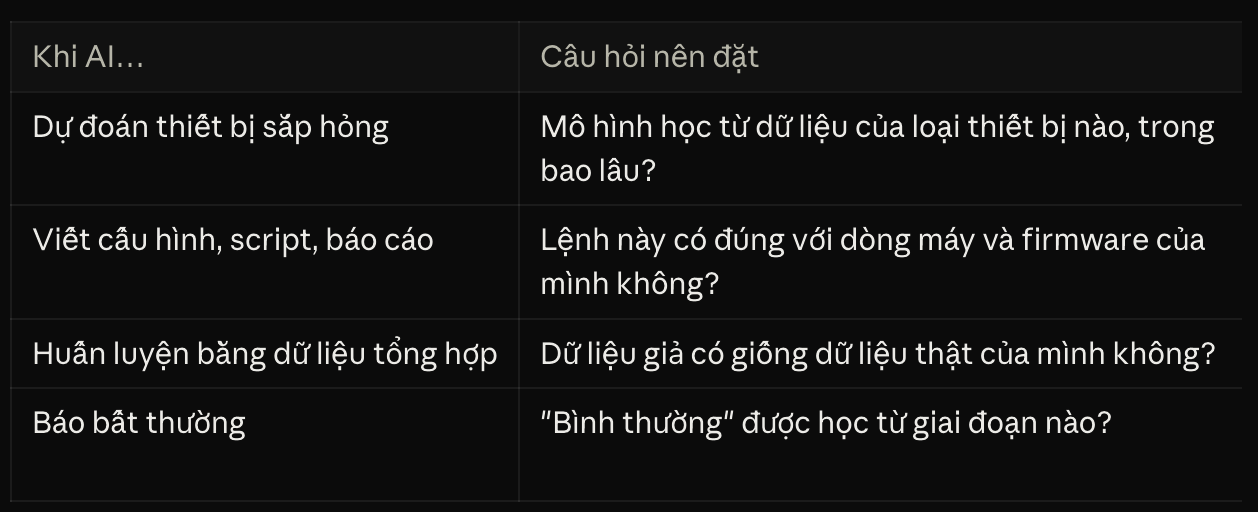
And a few habits I keep for myself:
Always demand evidence. A good alert must be able to point to which log, metric or event set it off.
Test in a lab or staging environment first. No exceptions for configuration written by AI.
Track the false alarm rate. A system that cries wolf ten times and is right once will teach the whole team to switch off the bell.
Beware of skewed data. A model that learned from off-peak hours will see peak hours as “abnormal”.
Record what the AI suggested and what you decided. The postmortem will need it later.
From “using AI” to “mastering AI”
I don't think every infrastructure engineer has to become a data scientist. But I believe one thing: whoever understands what their tool is doing inside will not be led around by the nose by it.
In the old days, we learned TCP/IP to understand why the network is slow, learned RAID to understand why data gets lost. Now we also learn Neural Network, GPT, GAN and VAE to understand why AI raises an alert, and why sometimes it is wrong. The root stays the same: understand the essence first, use the tool after.
AI will keep getting better. Our job is to get better along with it, not to hand our whole mind over to it.
Do what you love, and love what you do. And understand what you are using, too.
Where are you using AI in your operations work? Has it ever raised an alert, rightly or wrongly, that you still remember? Let me know.
This post draws on and expands a piece shared by VnPro about AI concepts for network engineers.